Last Updated: October 8, 2026
The CDC 7 day rule HIV testing before starting PrEP means one thing in practice: a patient needs a documented negative HIV test taken within the seven days before their first dose of pre-exposure prophylaxis. That is the whole rule. Everything else is workflow.
This guide from The Marketing Lab covers how clinics actually satisfy that window without slowing down the visit.
The window exists because of acute HIV infection. A person recently exposed can test negative on an antibody-based test and still carry the virus. Starting PrEP during that blind spot means the drug is the only thing in their system, and HIV can develop resistance to it.
CDC guidance on HIV testing before PrEP initiation treats a documented negative test inside the window as the minimum safeguard. The rule is not administrative box-checking. It is the difference between prevention and a resistant infection that is much harder to treat.
Key points for staff:
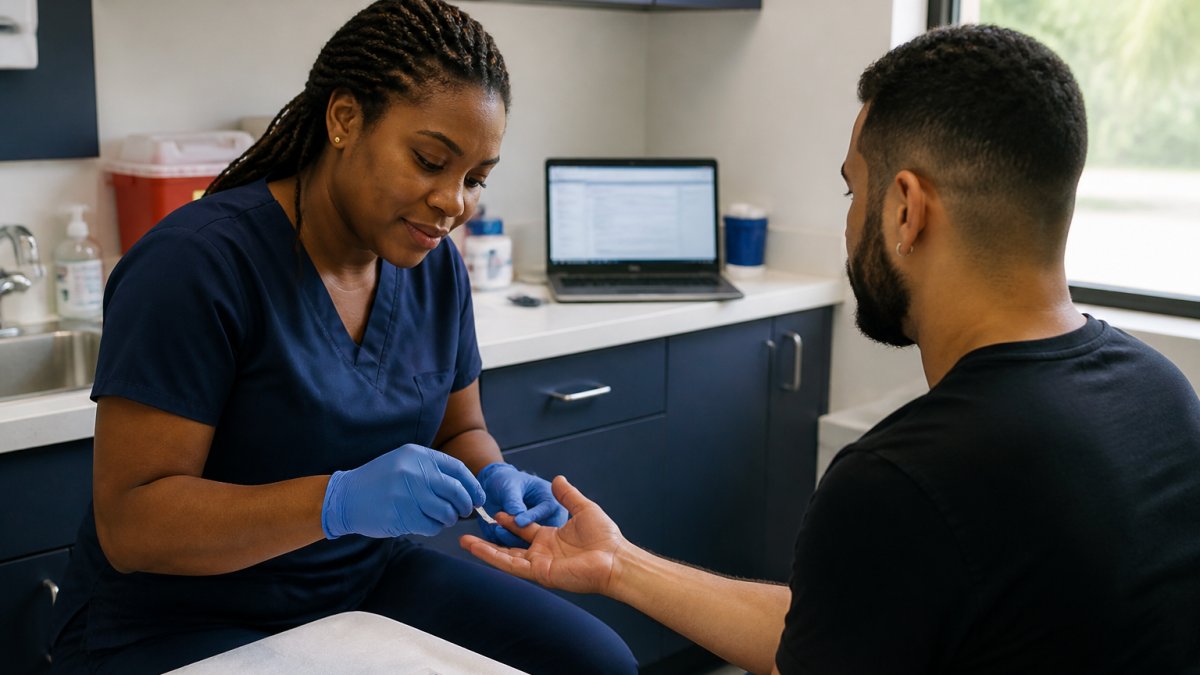
A rapid HIV test before starting PrEP counts as valid when it is a blood-based, CLIA-waived test performed and documented in the encounter, with a negative result inside the seven-day window. A fingerstick rapid test at rooming is the workhorse here because it returns a result in minutes and lets the visit move forward the same day.
What does not count:
Laboratory testing carries the strongest documentation, but it takes time. A fourth-generation antigen/antibody test with reflex RNA drawn against an open order confirms status within 24 to 48 hours. That is too slow for a same-day start unless a rapid test covers the window in the meantime.
Here is how the three options compare:
| Test type | Turnaround | Satisfies the 7-day rule? | Best use |
|---|---|---|---|
| Rapid fingerstick | Minutes | Yes, if documented in the encounter | Same-day start |
| Lab Ag/Ab with reflex RNA | 24-48 hours | Yes, once resulted | Confirmation and baseline |
| At-home kit | Days | Only with a structured result in the chart | Not for same-day start |
Same-day start works when the rapid test is built into rooming rather than added as a separate task. The medical assistant performs the fingerstick, the result posts to the chart, and the provider reviews it before the exam.
The sequence that holds up:
That last step matters more than most clinics treat it. A same-day start with no booked follow-up is a start that quietly lapses.
The seven-day window is easier to run when staff can see it on a calendar. Here is what a clean same-day start looks like, and what changes when the visit slips.
| Day | Action | Rule status |
|---|---|---|
| Day 0 (visit) | Rapid HIV at rooming, negative; baseline panel drawn; first dose given | Satisfied, test and dose same day |
| Day 1-6 | Patient starts medication at home (oral) or returns for injection | Still satisfied, dose inside window |
| Day 7 | Last day a first dose can go on the Day 0 test | Satisfied, edge of window |
| Day 8+ | First dose has not happened | Not satisfied, repeat HIV test before starting |
Delays happen: the pharmacy is out of stock, the patient reschedules, the prior authorization on injectable PrEP drags. The rule does not bend for any of those reasons.
A negative test inside seven days clears the patient to start. It does not mean the patient is protected on day one. Oral PrEP reaches maximum protection after roughly seven days of consistent dosing for receptive anal sex and longer for other exposure routes; injectable PrEP has its own lead-in schedule.
That distinction matters for counseling. A patient who starts PrEP on Friday and has condomless sex on Saturday is not yet at full protection. Pair the start with a plain-language conversation about the lead-in period and, where appropriate, a bridge strategy.
In our experience, the clinics that hold the window most reliably share three habits: (Source: CDC's comprehensive guide to HIV testing)
For injectable PrEP, the same-day start has an extra failure point: an injection given at an appointment that was never checked in produces no encounter, no note and no charge. Standardize an injection order set so the drug, the administration and the HIV result all land on the same claim.
The baseline panel is drawn at the same visit as the rapid test, against an open lab order. Every result must land as a structured value in the EHR. Scanned results are invisible to reports and useless for follow-up.
| Test | CPT code |
|---|---|
| HIV Ag/Ab | 87389 |
| HIV-1 RNA | 87536 |
| Hepatitis B surface antigen | 87340 |
| Hepatitis B surface antibody | 86706 |
| Hepatitis C antibody | 86803 |
| Comprehensive metabolic panel | 80053 |
| Urinalysis | 81003 |
| Pregnancy test | 81025 |
| Syphilis | 86592 |
| Chlamydia / gonorrhea | 87491 / 87591 |
| Trichomonas | 87661 |
Every open lab order needs a named owner, and that owner should be the prescriber who ordered it. This is the step where programs quietly break. The order goes out, the patient leaves, and nobody checks whether the result came back.
What works in programs we run:
A pending result is not a negative result. Until the lab reports back, the rapid test is what carries the visit, and the open order needs a scheduled review.
Discordant results stop everything. If the antigen/antibody test and the RNA test disagree, treat it as possible acute infection until proven otherwise. Hold PrEP, repeat testing, and link the patient to care. The same applies to an indeterminate result.
Follow-up cadence depends on the regimen, and the cadence is what keeps the program defensible. Oral PrEP needs a visit every three months with an HIV test and STI screen, plus renal function every six to twelve months.
Injectable PrEP runs on its own clock:
Lapsed injections need a weekly recall worklist with a named owner. Automated reminders alone fail silently. When dose 2 slips past a month, check the reinitiation rules before the next injection.
The mistakes are predictable, and most of them are documentation problems rather than clinical ones.
The CDC 7 day rule HIV testing before starting PrEP is simple to state and easy to break in a busy clinic. The fix is not more policy.
That is the kind of infrastructure The Marketing Lab builds for clinics.
Get started with The Marketing Lab and build a PrEP workflow where the seven-day rule is a step in the visit, not an afterthought. Book a free 30-minute strategy call at https://thelab.marketing/schedule.
It means a patient needs a documented negative HIV test collected within the 7 days before their first PrEP dose. A rapid HIV test at rooming satisfies that requirement, so the prescription or first injection can go the same day. A 4th-generation antigen/antibody test drawn against an open order confirms the result within 24 to 48 hours. PrEP is not started if that test comes back positive or discordant.
Yes. A CLIA-waived rapid HIV test performed at rooming gives you a documented negative result inside the 7-day window, which is what the rule requires. Draw the confirmatory 4th-generation Ag/Ab with reflex RNA at the same visit against an open lab order, and have a named provider review it within 24 to 48 hours. If the confirmatory result is positive or discordant, stop PrEP and trigger linkage to care.
A standard baseline panel includes HIV Ag/Ab (87389), HIV-1 RNA (87536) when acute infection is suspected, HBsAg (87340), anti-HBs (86706), HCV antibody (86803), CMP (80053), urinalysis (81003), pregnancy test (81025), syphilis (86592), chlamydia/gonorrhea NAAT (87491/87591), and trichomonas (87661). Code the visit as preventive with Z29.81 and Z11.3 or Z11.4, never diagnostic, so the labs stay at $0 cost-sharing under ACA section 2713.
Hold or stop PrEP until the result resolves. A positive or discordant 4th-generation Ag/Ab with reflex RNA means possible acute HIV infection: do not continue PrEP, order HIV-1 RNA if not already drawn, and link the patient to HIV care the same day. Pending results need a named owner and a weekly worklist. In our experience, open lab orders with no assigned reviewer are the single most common reason a PrEP start stalls or a patient stays on medication they should have paused.
Bring us your patient acquisition, 340B program, or compliance bottleneck. We will show you what a 30-day launch looks like for your clinic — in English or Spanish, month to month, no long contract.